The vegetative shoot apical meristem consists of a small group of dividing cells, which give rise to leaf primordia in very regular and predictable temporal and spatial patterns. Organ positioning, or phyllotaxis, is characterized by the divergence angles between the organs, the most common angle being 137.5°, the golden angle. The quantitative aspects of phyllotaxis have stimulated research at the interface between molecular biology, physics and mathematics. We are interested in understanding the physical, chemical and mathematical basis of this regularity.
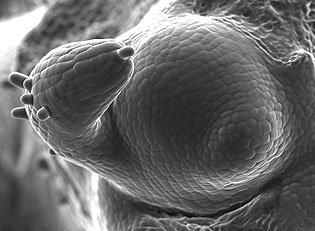
P1-P6 are existing primordia with P1 being the youngest. I1 and I2 are the next primordia to be formed
We used micromanipulation to topically alter chemical and physical parameters
thought to be important for meristem functioning. We reasoned that a
local relaxation of wall stress might influence organogenesis. Various
cell wall active compounds were loaded onto sepharose beads and applied
to defined positions on the meristem. Indeed, the cell wall protein expansin,
which induces cell extension in vitro (see: http://www.bio.psu.edu/expansins),
could be shown to induce leaf-like structures in aberrant positions.
Local application of purified expansin protein induces
a primordium at an ectopic position.
These experiments showed for the first time, that expansin is active
in vivo, and that local alteration of cell wall structure can induce
organogenesis. (Fleming et al.,
1997, 1998).
Interestingly, the expression pattern of the endogenous expansin, LeExp18, predicts the site of leaf initiation (Reinhardt et al., 1998).
Longitudinal and transverse sections through a tomato meristem. The expansin mRNA signal in red is visualized by in situ hybridization and marks I1, thus predicting the position of the next organ
In a search for additional
regulators, potentially upstream of expansin, we focused on the plant hormone
auxin. Treatment of tomato shoot apices with the auxin transport inhibitor
NPA caused a very specific developmental defect: leaf formation was completely
inhibited but stem growth and meristem maintenance proceeded normally.
The resulting structure is called an “NPA-pin” (Reinhardt
et al., 2000).
IAA application to NPA-pin restores leaf formation
When a vegetative tomato apex is grown on the auxin transport inhibitor NPA, the initiation of lateral organs is completely suppressed.
When the auxin IAA is applied to the flank of the NPA pin, leaf formation is restored at the position of application. Left: NPA-treated meristem; right, NPA-treated meristem to which IAA was locally applied
Similar results were obtained
ith the Arabidopsis mutant pinformed1, which has a mutation
in the putative auxin efflux carrier. Local IAA application also induces
lateral organ formation, but in this case, not leaves but flowers form
(Reinhardt et al., 2000).
Arabidopsis pin1 with
local auxin application
Localization of auxin transporters by immunocytochemistry
By immunological localization of the PIN1 auxin export protein we could show that auxin is likely to be redistributed towards the incipient primordia. Image by E. Bayer
We propose that auxin is redistributed in the meristem by a combination of diffusion and active transport. Our research indicates that both efflux and influx carriers are involved in setting up an auxin gradient within the meristem and that primordia are initiated at local auxin maxima (Stieger
et al., 2002, Reinhardt et al.,
2003b, Smith et al. 2006).
Our model differs in a subtle way from classical models. Rather than an inhibitor that emanates from the primordia, we postulate that an activator, auxin, induces new primordia. These primordia, in turn, serve as a sink and drains auxin from their surroundings, thereby specifying a minimal distance between adjacent primordia.
Models for phyllotaxis
Classical model
The primordia are a source of an unidentified diffusible
inhibitor, which prevents new organ formation in the vicinity of the source.
New model
Phyllotaxis is regulated not by an unidentified inhibitor,
but by an activator, auxin. The pre-existing primordia serve as sinks for
auxin, creating auxin minima in their vicinity.
This experiment-based model is qualitative in nature and rather intuitive. We wanted to construct a quantitative model that can explain the observed divergence angles. In collaboration with Przemyslaw Prusinkiewicz and Richard Smith from the Dept of Computer Science, Univ. of Calgary, we developed a computer simulation that is based on data about auxin transport combined with plausible assumptions (Smith et al. 2006). This model can recreate a variety of phyllotactic patterns. For a demonstration of a spiral pattern, see this movie.
The simulation can start from a radially symmetric embryo, produce opposite cotyledons, and then settle into a Fibonacci spiral. The patterns are stable and reproduce in vivo measured angles within one standard deviation. The model also faithfully recapitulates the phenotypes of the pin1 mutation and of selected experimental manipulations.
Image by Richard Smith
The picture shows the final stage of the simulation of spiral phyllotaxis. Auxin concentration in green, light green signifies high auxin concentration. PIN1 proteins are in red.