Warning: date(): It is not safe to rely on the system's timezone settings. You are *required* to use the date.timezone setting or the date_default_timezone_set() function. In case you used any of those methods and you are still getting this warning, you most likely misspelled the timezone identifier. We selected the timezone 'UTC' for now, but please set date.timezone to select your timezone. in /var/opt/vhosting/ips/botany/www/paleo_nav_e.php on line 79
last update: December 08, 2015 Webmaster
Reconstruction of past environmental change based on biotic proxies in lake sediments
The distribution of a range of aquatic and terrestrial indicator groups is strongly related to the environments they live in. Therefore their fossil remains in lake sediment records can be used to reconstruct past environmental change. We work on developing quantitative reconstructions of past environmental and ecosystem change, particularly focussing on fossil assemblages of Chironomidae (non-biting midges). A particular focus of this work has been on developing quantitative reconstructions of past summer temperature change in Europe and using these records to drive and evaluate landscape (e.g. vegetation) and climate models.
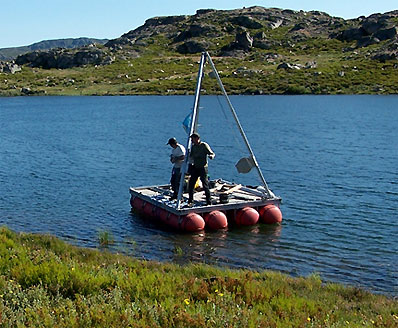
Fieldwork at Laguna de la Roya, Spain, to obtain a lateglacial sediment sequence
Recent publications
Renssen, H; Mairesse, A; Goosse, H; Mathiot, P; Heiri, O; Roche, DM; Nisancioglu, KH; Valdes, PJ
Multiple causes of the Younger Dryas cold period Nature Geoscience 8: 946–949 OCT 2015
Heiri, O; Ilyashuk, B; Millet, L; Samartin, S; Lotter, AF
Stacking of discontinuous regional palaeoclimate records: Chironomid-based summer temperatures from the Alpine region The Holocene 25 (1): 137-149 JAN 2015
Heiri, O; Brooks, SJ; Renssen, H; Bedford, A; Hazekamp, M; Ilyashuk, B; Jeffers, ES; Lang, B; Kirilova, E; Kuiper, S; Millet, L; Samartin, S; Toth, M; Verbruggen, F; Watson, JE; van, Asch, N; Lammertsma, E; Amon, L; Birks, HH; Birks, HJ; Mortensen, MF; Hoek, WZ; Magyari, E; Muñoz, Sobrino, C; Seppä, H; Tinner, W; Tonkov, S; Veski, S; Lotter, AF
Validation of climate model-inferred regional temperature change for late-glacial Europe Nature Communications: 4914 SEP 2014
Tinner, W; Colombaroli, D; Heiri, O; Henne, P; Steinacher, M; Untenecker, J; Vescovi, E; Allen, J; Carraro, G; Conedera, M; Joos, F; Lotter, AF; Luterbacher, J; Samartin, S; Valsecchi, V
The past ecology of Abies alba provides new perspectives on future responses of silver fir forests to global warming Ecological Monographs 83 (4): 419–439 NOV 2013
Henne, PD; Elkin, C; Colombaroli, D; Samartin, S; Bugmann, H; Heiri, O; Tinner, W
Impacts of changing climate and land use on vegetation dynamics in a Mediterranean ecosystem: insights from paleoecology and dynamic modeling Landscape Ecology 28 (5): 819-833 MAY 2013
Muñoz Sobrino, C; Heiri, O; Hazekamp, M; van der Velden, D; Kirilova, EP; García-Moreiras, I; Lotter, AF
New data on the Lateglacial period of SW Europe: A high resolution multiproxy record from Laguna de la Roya (NW Iberia) Quaternary Science Reviews 80: 58-77 NOV 2013
Eggermont, H; Heiri, O
The chironomid-temperature relationship: expression in nature and palaeoenvironmental implications Biological Reviews 87: 430-456 2012
Recent presentations
Heiri O
New challenges call for new approaches: An example focusing on past production of methane in lakes
Academia Europaea 26th Annual Conference. 16-18.7.2014, Barcelona, Spain. Invited presentation
Heiri O
Climate model–proxy-intercomparisons: Lessons learned from the EUCLIM project
AC2ME Workshop, The Royal Netherlands Institute for Sea Research (NIOZ), 22-26.6.2015, Texel, The Netherlands
Heiri, O
Stacking of discontinuous regional palaeoclimate records: Chironomid based summer temperatures from the Alpine region
At the frontiers of palaeoecology - seminar in honour of John Birks and his academic life, University of Bergen. 19-20.3.2015, Bergen, Norway
Heiri O
Lateglacial summer temperature gradients across Europe
Institute of Geography, University of Bern, 17.3.2015, Bern, Switzerland
Participants
Internal:
Oliver Heiri, Elisa Vescovi, Stéphanie Samartin, Willy Tinner
External:
Andy Lotter, Emi Kirilova (Utrecht University), Hans Renssen, Didier Roche (Vrije Universiteit Amsterdam), Steve Brooks (Natural History Museum London), John Birks, Hilary Birks (University of Bergen), Laurent Millet, Odile Peyron (Université de Franche Comte), Enikö Magyiari (Natural History Museum Budapest), Spasimir Tonkov (Sofia University), Castor Muñoz Sobrino (University of Vigo), Heikki Seppä (University of Helsinki), Siim Veski (Talinn University of Technology), Morten Fischer Mortensen (The National Museum of Denmark) and other colleagues
Temperature Reconstruction
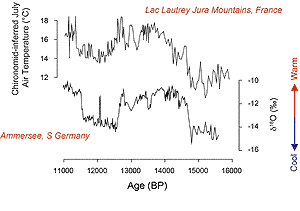
A chironomid-based reconstruction of past July air temperature from Lac Lautrey, France (Heiri and Millet, 2005), compared with a climate reconstruction based on oxygen isotopes in ostracod remains from Southern Germany (von Grafenstein et al., 1999).
 Institute of Plant Sciences